Replacing a physical guard with monitored cameras: what it actually costs, and what you get instead
One guard watches one direction from one spot, and needs breaks, sleep, and time off. An 8-camera monitored system watches every side of a property at once, all night, every night, for a fraction of the cost. Here's the real math, using current Southern California guard rates.
What a physical guard actually costs
Unarmed security guard billing rates in Los Angeles and Orange County currently run roughly $25–$45 per hour, depending on the agency, shift type, and contract length. That's the rate you're billed, not the guard's take-home pay — agency overhead, insurance, supervision, and management typically add 20–35% on top of base wages before it ever reaches your invoice.
Most properties don't just need an 8-hour shift — they need coverage after close, overnight, and on weekends, when almost every trespassing, dumping, and break-in incident actually happens. Round-the-clock coverage means paying for all 168 hours in a week, every week:
Rates reflect current published 2026 Southern California unarmed guard billing rates. Actual quotes vary by agency, contract length, and site risk. These figures also don't include overtime, holiday pay, or the cost of covering a shift when a guard calls out.
What 8 monitored cameras cost
We use 8 cameras as a reference point because that's typically enough to cover every exterior side and entry point of a standard commercial property — front, rear, sides, parking, and loading areas, with no blind corners left uncovered. Live monitoring runs $100 per camera, per month, covering trained operators watching your feeds around the clock, not just recording them.
That's roughly $9,600 a year for full-perimeter, round-the-clock coverage — against $216,000–$259,000 for a single 24/7 guard post. Even a guard scaled back to overnight-only coverage still runs over $122,000 a year, more than 12 times the cost of 8 monitored cameras.
One set of eyes vs. every side, all the time
Cost is only half the comparison. A guard, no matter how good, is one person who can face one direction at a time. If they're watching the front gate, they're not watching the loading dock. If they're on a patrol lap around the building, there's a stretch of time — often 20–30 minutes — where every side of the property is unwatched simultaneously. That's not a knock on the guard; it's just physics. One set of eyes can't be in eight places at once.
Eight cameras monitored from a central station solve that structurally. Every side of the property is being watched at the same moment, continuously, by operators who can pull up any feed instantly the moment something looks wrong — no walking, no delay, no blind rotation between posts.
The problems that come with a human standing post
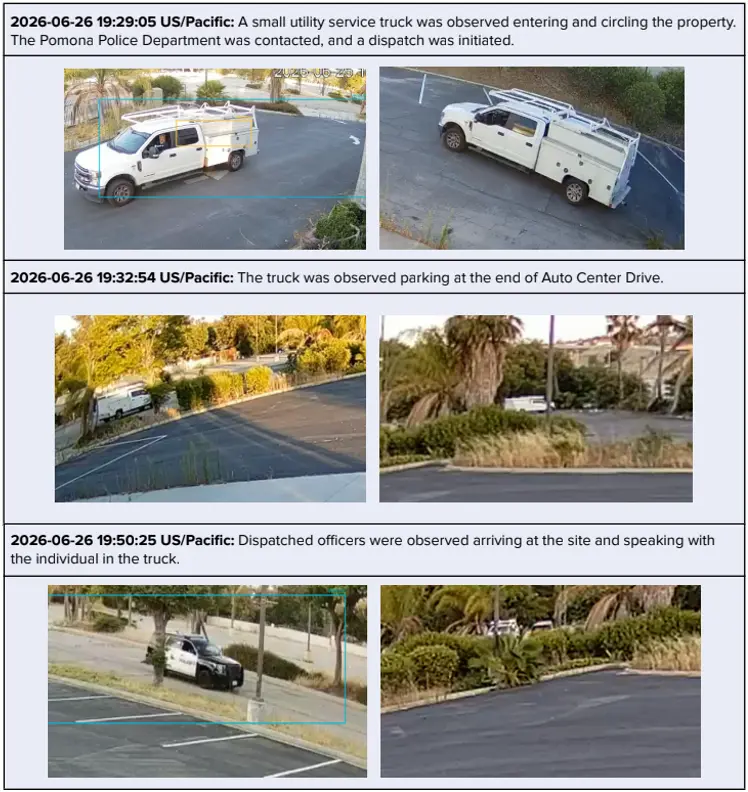
Actual monitoring log: a utility truck was flagged circling the property and parking nearby. An operator reviewed the activity, contacted police, and a dispatch was initiated — with officers arriving on scene to speak with the individual. That's the kind of end-to-end response a single guard, watching one direction at a time, could easily miss.
Why AI analytics make monitoring even more effective
Modern monitored camera systems don't rely on an operator staring at 8 feeds hoping to catch movement. AI-powered video analytics continuously scan every camera for motion, loitering, and perimeter activity, and instantly flag anything that looks like it needs a human look — the operator is pulled directly to the exact feed and moment something happened, rather than scanning blindly.
That combination — AI doing the tireless watching, a trained human doing the judgment call — is what makes monitored cameras outperform a person standing alone. The AI never gets tired, never checks a phone, and never misses a corner of the property because it was looking somewhere else. And because a live operator verifies every flagged event before acting, false alarms get filtered out instead of triggering unnecessary responses.