One network, two buildings: a wireless bridge for a pharmaceutical equipment manufacturer
A pharmaceutical equipment manufacturer outgrew its headquarters and purchased a second building down the street, about 620 feet away, to expand operations. The new building needed to run on the same network as headquarters: same servers, same cameras, same phones, same firewall. Instead of paying for a second internet circuit and stitching the two locations together over the public internet, we bridged them wirelessly with a point-to-point radio link.
The problem: growth down the street, not next door
The client manufactures precision equipment for pharmaceutical production, and had outgrown the space at headquarters. Rather than relocate, they purchased a second building down the street, roughly 620 feet away, to expand manufacturing capacity. Both locations needed access to the same file servers, the same camera system, the same VoIP phones, and the same internet gateway, but only headquarters had a wired connection to the outside world.
The obvious fix is to run a second internet circuit into the new building and treat it as its own site. That works, but it also means a second router, a second firewall, a second set of rules to maintain, and two separate networks that need to be stitched together with a VPN just to share the printers and the camera feeds. It's more hardware, more monthly bills, and more places for something to go wrong. What the client actually wanted was simpler: make the new building behave like it's plugged into the same switch as headquarters, even from 620 feet down the street.
Why a point-to-point radio bridge
A point-to-point (PtP) wireless bridge is exactly what it sounds like: two radios, mounted on masts with clear line of sight to each other, that pass network traffic between two locations at multi-gigabit speeds without a single strand of fiber or copper run between them. For two separate parcels down the street from each other, trenching conduit under a public street and sidewalk means permits, traffic control, and a lot of digging just to connect two buildings the client already owns. A wireless bridge skips all of that, and once it's up, the two buildings function as one Layer 2 network. Every device on either end sees the same network, the same servers, and the same internet gateway, with no VPN tunnel or second set of firewall rules required.
This client had already purchased their own Ubiquiti airFiber AF-5U radios, a purpose-built 5 GHz high-band PtP radio designed for exactly this kind of short-to-medium range backhaul link, and brought us in for the design, mounting, and installation. That works well for us either way: if you already own the hardware, we're glad to install and configure it, and if you don't, we can spec and supply the radios ourselves as part of the job. Either path lands at the same result.
At roughly 620 feet between the two buildings, and with clean line of sight down the street, the AF-5U delivers well more bandwidth than either building's servers, cameras, or phones will ever need, with plenty of headroom for future growth.
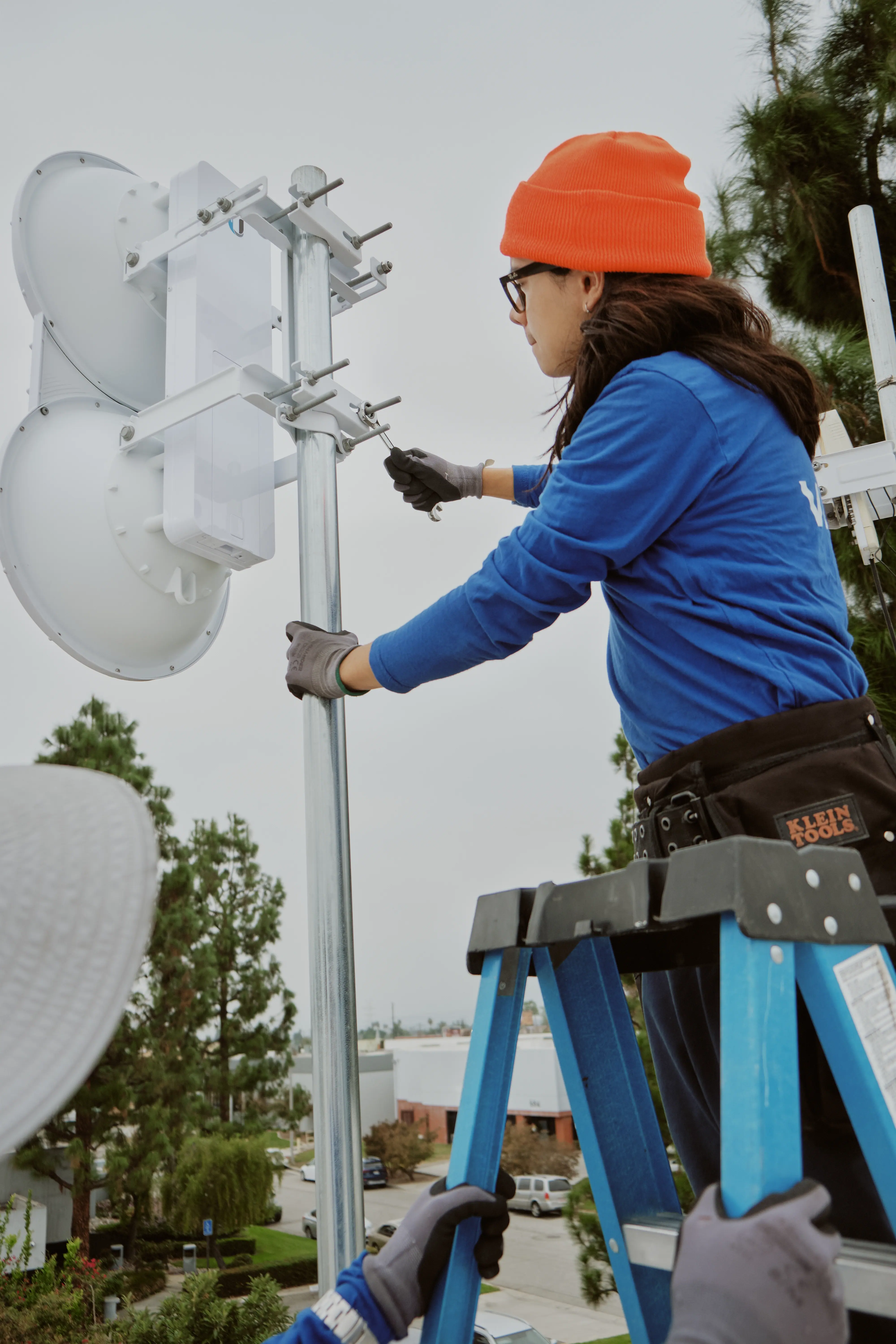
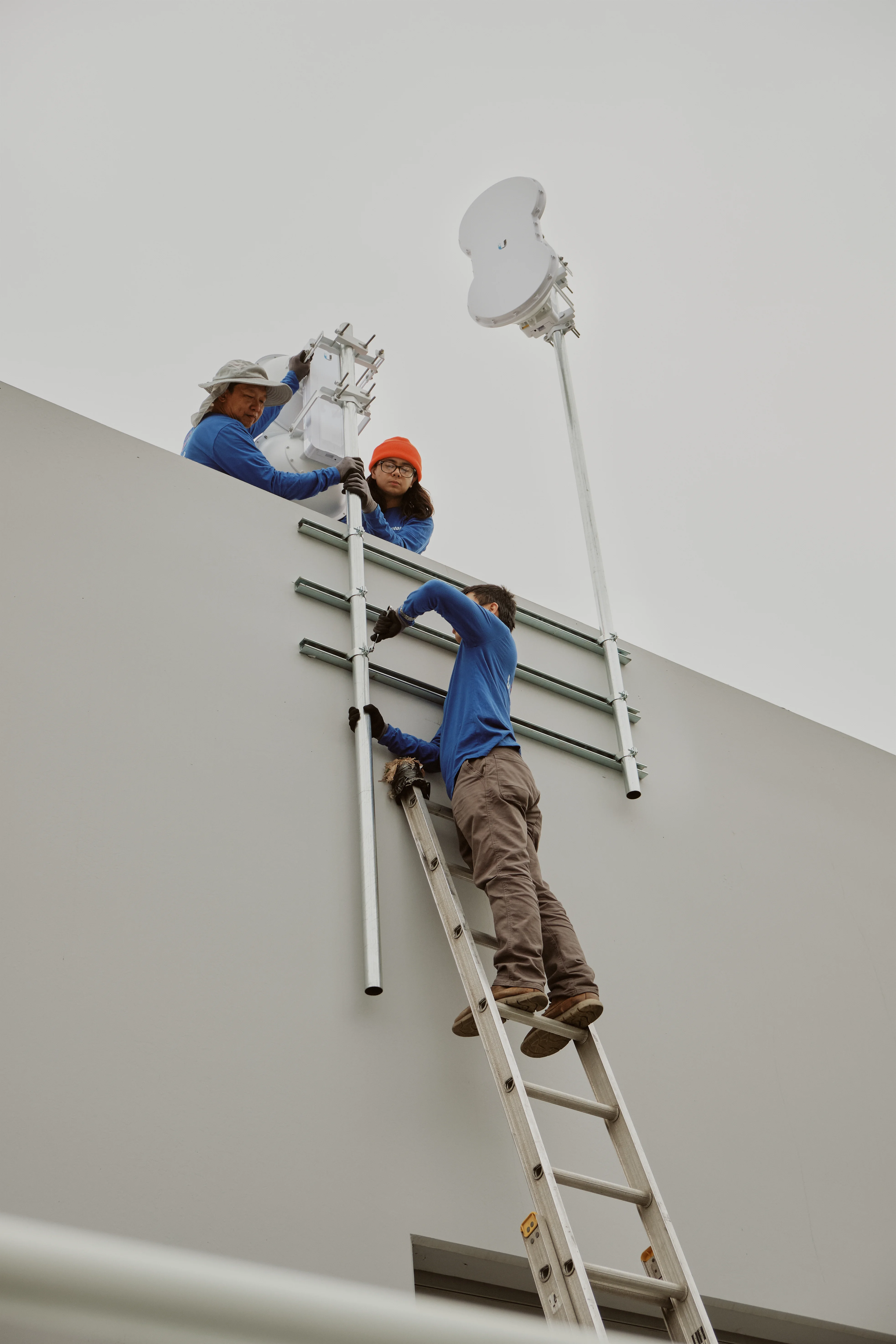
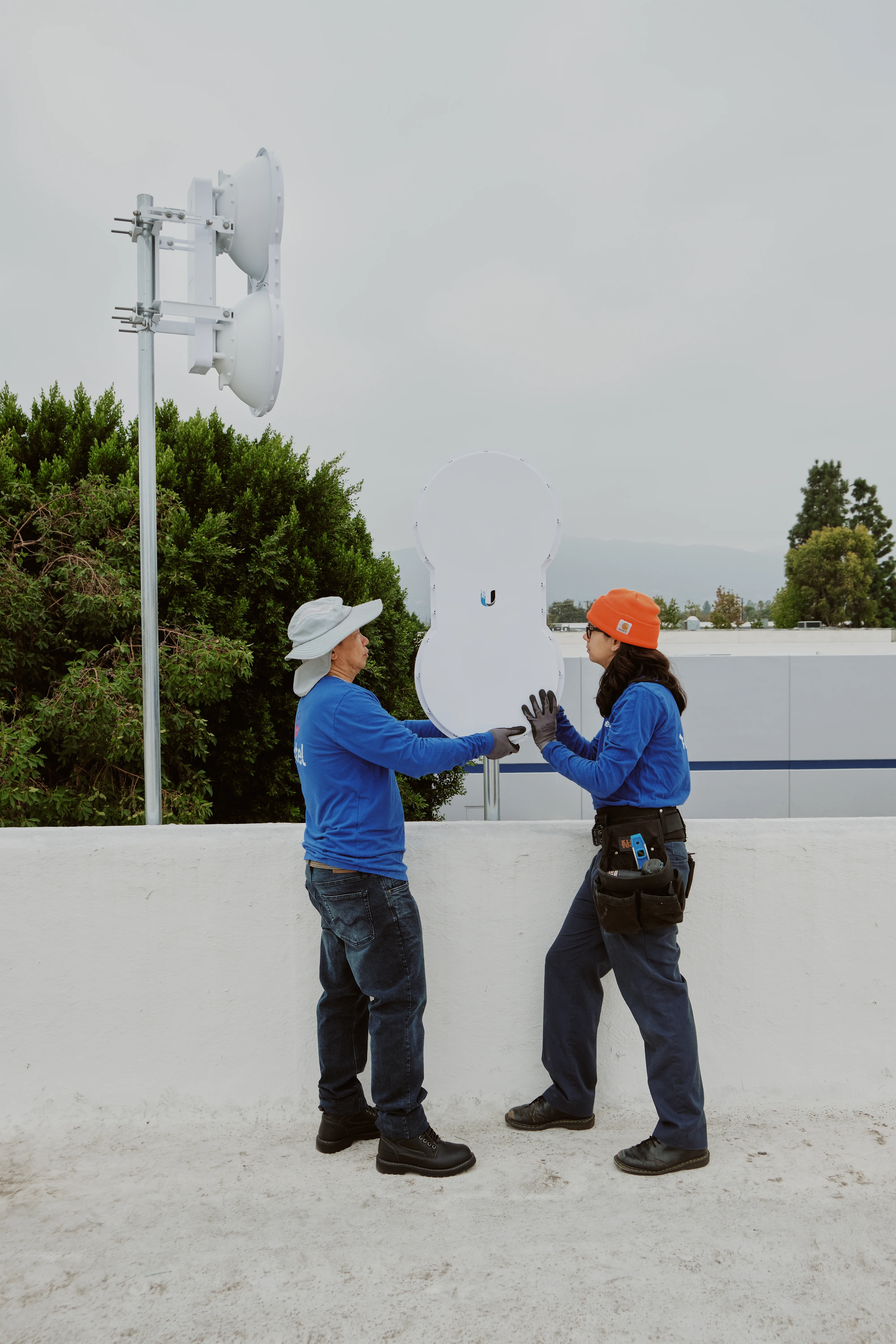
AllTime Systems technicians installing the Ubiquiti airFiber AF-5U radios on the rooftop mast, running conduit and mounting struts, and staging each dish before final alignment for the point-to-point bridge.
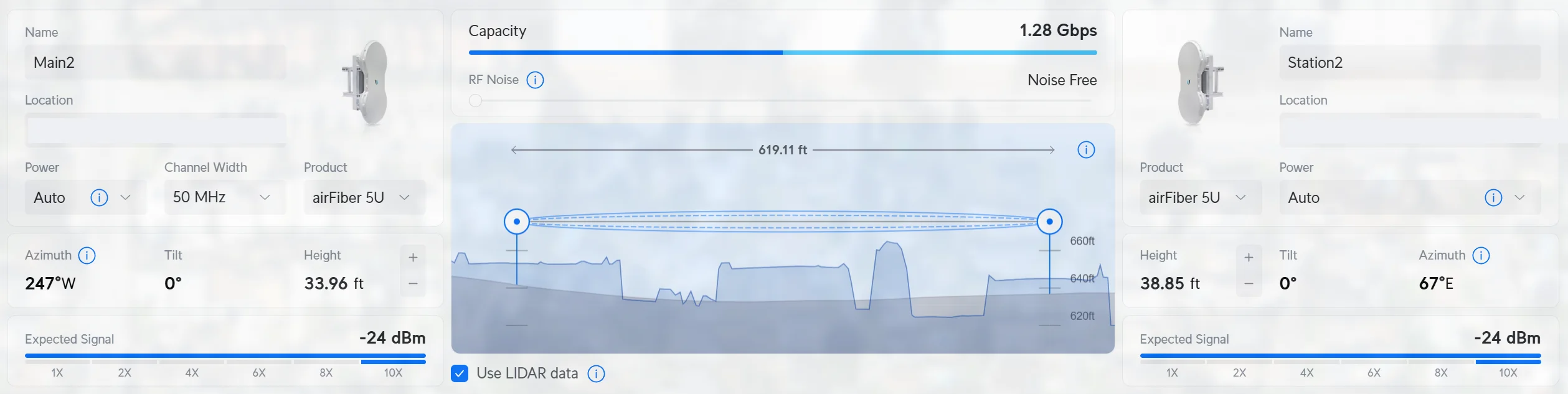
Before any hardware went on the roof, we ran the link through Ubiquiti's planning tool using LIDAR terrain data to confirm a clean, obstruction-free path between the two buildings, 619 feet apart, and to model expected signal and throughput ahead of installation.
Grounded and bonded, not just bolted on
Rooftop radio equipment is exposed equipment, and it's also the highest point on the building, which makes proper grounding non-negotiable. On both ends of this link, we grounded the AF-5U radios themselves, and we bonded the metallic EMT conduit and mounting struts supporting the mast back to the building's grounding system as well. That means a lightning strike or static discharge has a clear, low-resistance path to ground, instead of a path through the network cable and into the switch it's plugged into.
We also ran shielded, outdoor-rated CAT6 from each radio down to its building's network closet. Shielded cable matters here for two reasons: it's built to survive UV exposure and temperature swings outdoors without degrading, and the shielding itself drains induced electrical noise to ground rather than letting it ride into the network electronics. It's a small detail that's easy to skip and expensive to regret, especially on a rooftop installation that isn't easy to get back up to and redo.
What it actually cost, versus a second internet line
The installation cost for this job, mounting both radios, mast and roof work, grounding and bonding, and shielded cable runs to each network closet, ran $2,500. Because the client already owned the AF-5U radios, that $2,500 covered labor and mounting materials only. For a client who needs us to supply the radios as well, radio hardware comes in a wide range of pricing depending on the distance, bandwidth, and reliability needs of the link, typically somewhere between $100 and $2,000 per pair of radios, on top of the installation cost. Either way, it's a one-time project cost, with no recurring bill attached to the link itself.
The alternative, a dedicated business internet circuit installed into the second building, typically runs somewhere in the range of $150 to $400 or more per month depending on the provider and bandwidth tier, on top of its own installation and equipment costs. At $250/month as a conservative middle estimate, that's $3,000 a year, every year, for a service that still leaves the two buildings on separate networks requiring a VPN to talk to each other. The wireless bridge pays for itself inside its first year and keeps paying for itself every year after, while also giving the client a simpler, single network to manage instead of two.
| Option | Year 1 | Year 5 | Ongoing? |
|---|---|---|---|
| airFiber PtP bridge, install only (client-owned radios) | $2,500 | $2,500 | No monthly cost |
| airFiber PtP bridge, radios + install (AllTime-supplied) | ~$2,600–$4,500 | ~$2,600–$4,500 | No monthly cost |
| Second internet circuit | ~$3,000+ | ~$15,000+ | Yes, every month |
The trade-offs worth knowing
A wireless bridge isn't the right call for every site, and it's worth understanding both sides before choosing it. On the upside: one network, one gateway, and one firewall to manage instead of two, no monthly circuit charge, fast deployment compared to trenching, and full-speed access to shared servers, cameras, and phones from either building as if they were on the same switch.
On the other side: the link needs clear line of sight between the two radios, so a future building, sign, or row of trees along the street could interrupt it. Both buildings also now share a single internet connection and a single point of failure at the main gateway, so if that connection goes down, both locations lose outside access at the same time. For this client, with a clear sightline down the street between the two parcels and a strong preference for one unified network instead of running conduit under a public street, those trade-offs were an easy call. For a site without line of sight, or one that needs guaranteed independent internet access for each building, a second circuit is still the right answer.
Have multiple buildings that need to act as one network?
Whether it's a manufacturing yard, a warehouse and an office next door, or any two structures with clear line of sight between them, a point-to-point bridge can often connect them faster and cheaper than trenching conduit or paying for a second circuit every month. Our technicians hold Ubiquiti's UNS (UniFi Network Specialist) certification, and every install is grounded and bonded properly the first time, no shortcuts on the rooftop work that's hardest to redo.