The labor force behind the network: structured cabling for a real estate office move
A real estate company moving into a new office needed every desk, workstation, and access point wired before move-in day. Their IT partner brought us in as the boots-on-the-ground labor force to run and terminate the structured cabling, on schedule, so their own engineers could focus on the network itself.
The problem: a network needs hands, not just a plan
This client's IT partner had the network design worked out: switch locations, patch panel counts, jack placement at every desk and workstation. What they didn't have was a crew on the ground to actually pull the cable, terminate hundreds of ends, and get it all tested and labeled before the move-in deadline. That's a common gap for IT companies. Design and configuration is their expertise; running physical cable through ceilings, walls, and furniture across an entire office floor is a different skill set and a different set of hands entirely.
That's exactly where we came in. The IT partner handled the design and the eventual network configuration; we handled the physical labor of getting copper and fiber cable from the MDF to every jack in the building, terminated correctly and labeled clearly.
Why IT companies bring us in as their labor partner
IT companies are experts at networks: configuring switches, setting up VLANs, hardening a firewall, keeping a system running. What most of them don't keep on staff is a full crew of licensed, experienced low-voltage installers ready to deploy to a job site and pull thousands of feet of cable in a matter of days. Staffing that in-house for every project isn't practical, especially for a firm juggling several client sites at once.
We fill that gap. Our crews show up, run both copper and fiber to spec, terminate every jack and patch panel port correctly the first time, and label everything clearly, so when the IT partner's engineers arrive to configure the network, every port does exactly what the design called for. No guessing which cable goes where, no re-pulling a run that was terminated wrong, no delays waiting on labor that was never secured.
For this real estate office, that meant every workstation jack, tested and labeled, tied back cleanly to a patch panel at the rack, ready for the network team to bring the office online on schedule.
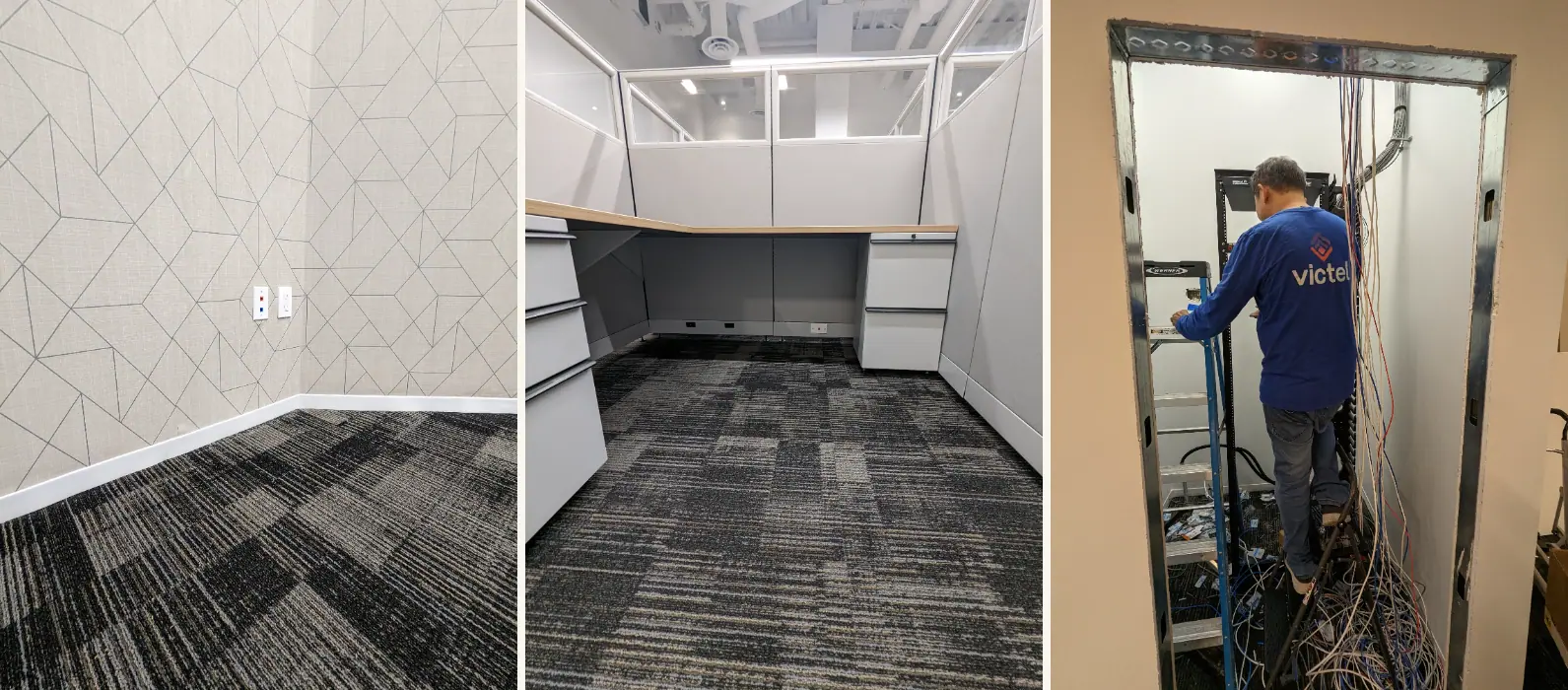
Left to right: a labeled data and power jack pairing at a workstation, a finished cubicle with clean, low-profile floor drops, and our technician terminating cable at the MDF rack ahead of the client's move-in date.
The kind of details that matter to an IT partner
A patch panel with unlabeled or inconsistently labeled ports turns a five-minute troubleshooting call into an hours-long hunt through walls and ceilings. On this job, every jack and every corresponding patch panel port carries a clear, consistent label, so anyone, whether that's our crew, the client's IT partner, or a different technician entirely years from now, can trace a connection in seconds instead of guessing. Every run was also tested and certified before we called it done, not just pulled and hoped for the best.
That level of care is what an IT company is actually buying when they bring in a labor partner. It's not just extra hands, it's hands that know how to do the work the way a network engineer needs it done, so the handoff back to their team is seamless.
Need a trusted labor force for your next cabling project?
If your team designs and configures networks but needs experienced hands on the ground to run and terminate copper and fiber, we regularly partner with IT companies as their installation crew. You bring the design; we bring the labor, done right the first time.